
In the hope that thanks to vaccines we can soon get out of this state of emergency and return to our normal lives, I thought it would be useful to give you some information regarding diving activities for people affected by COVID-19 infection.
A dive is an activity that can physically stress our body. Our lungs have to cope with pressure changes, changes in the density of the gases breathed, changes in the partial pressures of gases, and the need to eliminate inert gases. Likewise, our cardiovascular system has to cope with the centralization of blood volume, increases in systemic blood pressure and thermal stress, just to name a few. These stresses require a good level of physical fitness in our body, able to safely handle all these variations. This is exactly what the doctor checks during a medical examination for divers: whether your body’s fitness is sufficient to handle the challenges of diving.
By now we have all heard of COVID-19; we will remember the year 2020 for the pandemic and for what this virus causes, which in some cases presents with more severe symptoms than in others, and in other cases is even completely asymptomatic. Scientific studies on COVID-19, or severe acute respiratory syndrome coronavirus 2 (SARS-CoV-2), are constantly being updated, but there is still much we don’t know about this disease.
The long-term effects of COVID-19 are still unknown, but if this virus behaves similarly to other already known coronaviruses (MERS or SARS-CoV-1), then the available studies and data tell us that it could cause long-term damage. Furthermore, clinical publications show cases of severe deterioration of the lungs, heart, central nervous system and kidneys following COVID-19 infection.
Can these long-term effects have repercussions for a diver practicing diving?
The answer known so far comes from the available scientific publications: the pathophysiology of COVID-19 in relation to diving, studies and experience with similar diseases. Based on this evidence, the main concerns for divers and dive safety are:
– Residual lung disease from COVID-19 results in decreased exercise capacity. Divers experience greater respiratory resistance while diving due to reduced chest wall compliance, higher density of the air breathed, and reduced volume as a result of fluid shifts in the body. This could be too much for lungs with residual damage after COVID-19 infection.
– Residual scarring, fibrosis and structural abnormalities such as “blebs” or “bullae” in the lungs increase the risk of pulmonary overexpansion injuries in a diver during an ascent.
– Residual lung disease, damage to the alveoli and pulmonary vascular system could result in less effective gas exchange, and with it inadequate elimination of nitrogen during a dive, leaving the diver at greater risk of developing decompression sickness.
– A COVID-19 infection may possibly predispose a person to a higher risk of coronary artery disease, heart failure, cardiomyopathies and hypertension. The increased demands placed on the heart by diving make these cardiovascular abnormalities a contraindication to diving. They are well-known risk factors for diving-related pulmonary edema and fatal diving accidents.
– Decompression sickness is believed to be a prothrombotic inflammatory state. A high rate of venous thromboembolism, found in COVID-19 patients, could influence or predispose divers to developing decompression sickness.
Although many, if not all, of these listed factors have not been proven, it is not surprising that there is nonetheless a great deal of caution among hyperbaric physicians. Therefore, based on the best available evidence, EUBS has drawn up guidelines for assessing fitness to dive for divers affected by COVID-19 infection. These are recommendations, therefore not obligations. But if you ask me, I would say:
Better safe than sorry, especially in diving medicine!
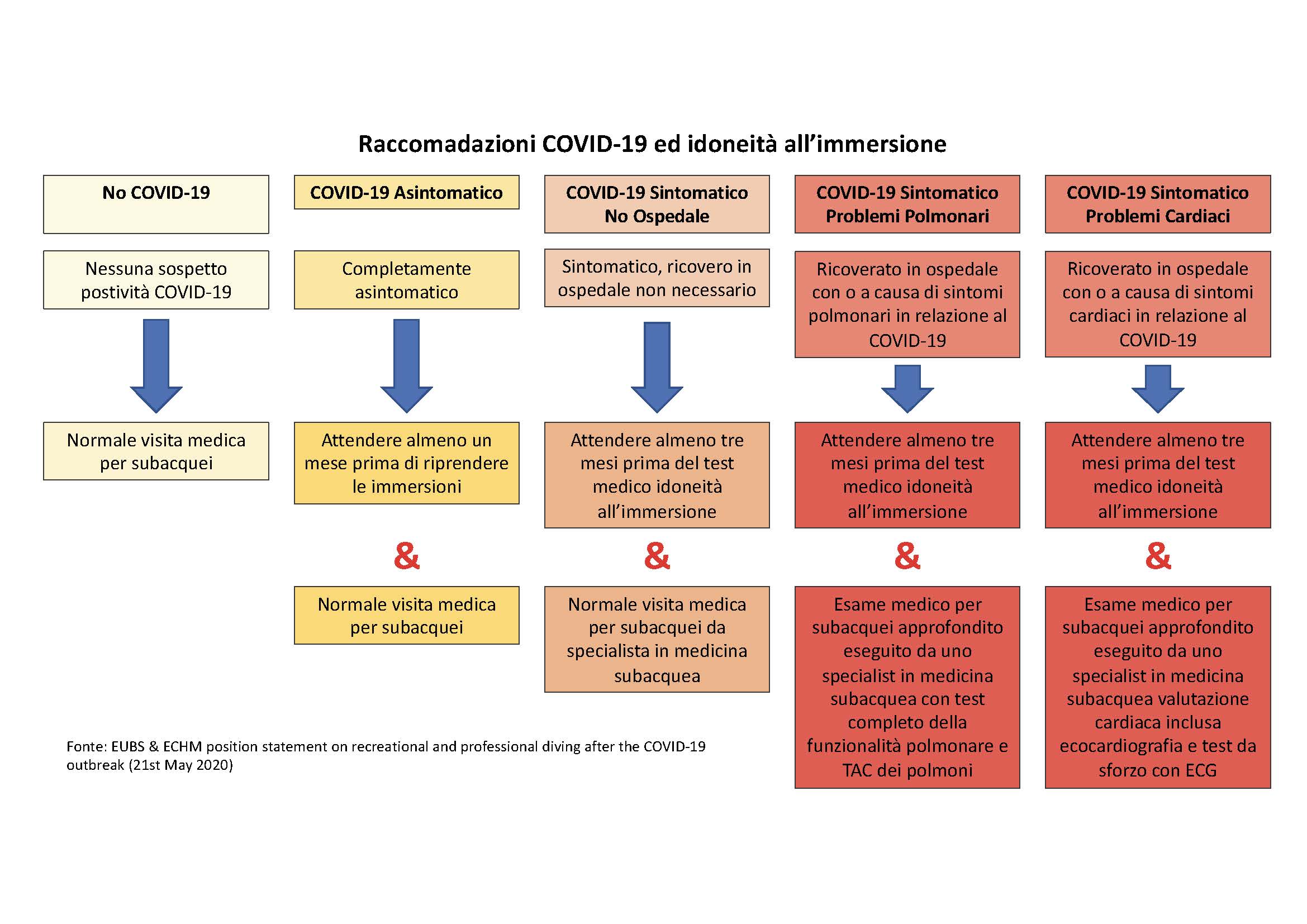 In the diagram, I have summarized the May 21, 2020 recommendations from EUBS (European Underwater and Baromedical Society) and ECHM (European Committee for Hyperbaric Medicine) regarding recreational and professional diving for people who have had a COVID-19 infection.
Esther
Related news