There has been a lot of attention lately on the topic of climate change; fossil fuels, the greenhouse effect, plastic ending up in the sea. The impacts these have on the wellbeing of the earth, and especially on the wellbeing of the oceans and the sea, are devastating. During dives in various parts of the world, and here in Italy, we have seen the changes with our own eyes: pollution, wonderful marine creatures sadly feeding on plastic, changes in underwater habitats with drastic declines of some species and invasions of new species due to rising water temperatures.
“For years we thought the oceans were so vast and the inhabitants so infinitely numerous that nothing we could do would ever have an effect on them. But now we know that was wrong …” Sir David Attenborough
Even though many of us now know much more about the terrifying damage we have caused to the oceans and seas, it remains sad to see how many people are still underestimating, or are even completely unaware of, the problem. Right now we’re at a critical point where we need to act if we still want to be able to protect the natural beauty of the world.
We believe that awareness and education are of crucial importance, since recognising the problem is the first step towards a solution. But even more, we believe that today’s children can be the main driving force in helping us give it a chance.
“Our house is on fire. I am here to say, our house is on fire.” Greta Thunberg
As divers, as lovers of the oceans and seas, we feel we simply cannot watch everything that is happening and do nothing. Therefore, even if only a small brick in a huge wall that needs to be built, we wanted to do our small part to make a change.
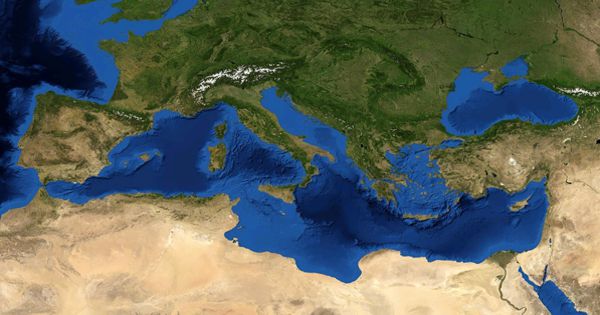
So, last year we joined the Scuola d’Amare project, a project founded by Fabio Figurella, PADI regional manager for Southern Italy. With this project, diving instructors and dive centers go into schools to teach about environmental issues around the world, focusing on the threats facing the Mediterranean Sea.
The natural heritage of our Mediterranean Sea is priceless, with unique natural habitats, thousands of plant species and numerous animal species. To protect this natural heritage, we believe it is essential that every citizen always and consistently acts according to “eco-sustainability”. To make this possible, it is necessary to draw and amplify society’s attention to these issues concerning marine environments. Creating a new sense of civic responsibility, in which there is an understanding of the value of the sea and the oceans. Respect and a high sense of individual responsibility can be built by starting with effective and enjoyable education for future generations about the environment, using a sport that is closely connected to protecting the underwater environment: diving.
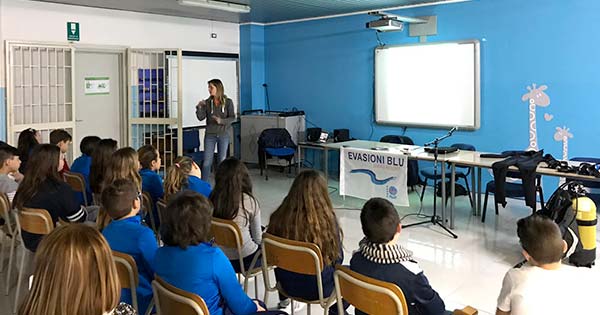
So, this year, in collaboration with the “Alcide de Gasperi” school in Capaci, we went back to the classroom! The many 8-11 year old children we met were enthusiastic and very interested in the subject, which of course gave us a great sense of satisfaction. But what surprised me was how much these kids taught us. I just wanted to highlight a few things that really made us stop and think:
– During a slide of our presentation showing entangled marine animals, a girl started crying: “It’s terrible that they have to suffer simply because of our carelessness.”
– At the end of one of our presentations, a boy had something to say: “In summer we always go to the beach with my mum and dad and we bring food and drinks, something really nice that I love. Once I collected all the rubbish in a plastic bag, because at school they taught me not to pollute beaches and natural environments. But at the end of the day, when I wanted to take the rubbish bag with me to throw it away somewhere, my dad told me to leave it on the beach. He said it’s the council’s job to clean the beaches; that’s why he pays taxes. I felt bad, but we left the rubbish bag on the beach.”
– “I often go out to sea on a boat in summer, which is great! I go fishing with my dad and a friend. But a lot of the time my dad’s friend, who smokes, throws his cigarette butts into the sea, and I’m not really sure what I can do about it, because he’s an adult.”
– “When my mum goes to the supermarket, she always brings her own bags, because she taught me that we should try not to use plastic bags. But when she buys fruit and vegetables and hands the bags to the seller, he always looks at her strangely. The last time, when we were leaving, he started laughing with another girl who works at the supermarket, and I know it’s because they’re making fun of my mum.”
– One thing I’ll never forget is how, at the end of our presentation, a girl came up to me. I thought she had a question and leaned down a bit to try to hear her better amid the chaos of the children’s noise. Instead of a question, I got a kiss on my cheek and a “Thank you!”, after which she turned around and followed the rest of the class out of the room.
We have a saying in Dutch, “Jong geleerd is oud gedaan”, which translates as “what is learned young will be put into practice when grown”. Fortunately, we see that most children care a great deal about environmental issues and protecting our seas. Some children already know a lot about this topic, thanks in part to some wonderful teachers we’ve had the pleasure of meeting. Some children are much more aware and attentive to this topic than most adults. Together with them, we hope for a better future for our blue planet! Hoping that we, as adults, will also start thinking like adults, the way some of the children among us already are…
Related news