I’ve been lucky enough to go diving in different parts of the world. For those who, like me, love diving, you simply have to have diving experiences in other seas. We divers, deep down, are explorers, and as such we love having new experiences and exploring new environments.
If I have to tell you which dives stirred up the most emotion in me, and above all were the most fun, I have to say the ones done in the Mediterranean Sea!
Sure, the great coral reefs, the countless fish of every shape and color that live there, are fascinating. The big encounters with sharks, manta rays, whales, turtles, were exciting, but what I noticed is that the landscapes at these dive sites were always the same, almost monotonous. Obviously, this is just a personal opinion!
I know, maybe I’m biased — the Mediterranean is my home sea, the place of my childhood, of my first swims, of my first scuba dives with tanks.
The Mediterranean Sea, for me, has its own special reason — it’s a sea of great importance in terms of biodiversity, and not only that. The morphology of the seabeds at the dive sites — walls, shoals, rockfalls, caves — the strong colors of deep blue contrasting with rocks often covered in the vivid colors of benthic life. The clarity of its waters, intrinsic qualities that are hard to find in other seas, and above all an incredible variety of native species characterize its environment. These elements make it unique, fascinating and full of surprises. Let’s get to know these dives, these dive sites, this sea, the MARE NOSTRUM, a little better.
The origins of the Mediterranean Sea.
It all begins about 200 million years ago, when there existed a single continent called Pangaea, surrounded by a single ocean called Panthalassa. Within this great continent, an enormous rift formed to the east, creating a gulf called the Tethys.
The Tethys Sea was a warm sea similar to the tropical seas we know today, and it was from this portion of sea that what we know as the Mediterranean Sea originated.
Over several million years, this portion of sea underwent great upheavals due to the drift of the African and European continents.
In an initial phase, the movement of the continental plates closed off the gulf on the eastern side, later bringing the Tethys Sea into contact with the Atlantic Ocean. The slow but continuous movement of the continental plates caused this passage to close, effectively preventing any exchange of water with the oceans. The evaporation of the waters of the now-closed basin caused enormous salt flats to form.
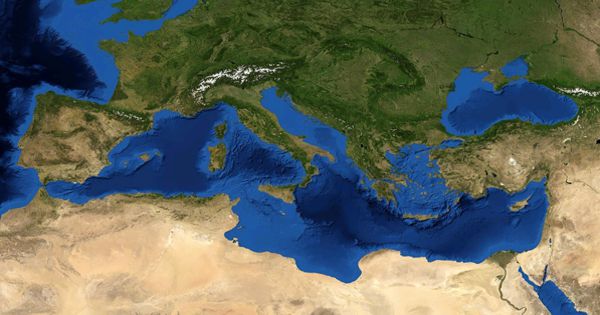
About 5.5 million years ago, due to a powerful earthquake, a new opening formed on the western side that re-established communication with the Atlantic Ocean. This passage is the Strait of Gibraltar. Over a couple of millennia the basin filled up, thus taking the shape of what would become the Mediterranean Sea.
In the following millennia, the Mediterranean Sea underwent further changes due to periodic ice ages that raised its average level. Later, during warmer periods, its waters retreated by more than 100 meters.
From then until today, the average level of the Mediterranean has risen, not steadily, but with periods of standstill followed by renewed rises.
To be continued….
Related news