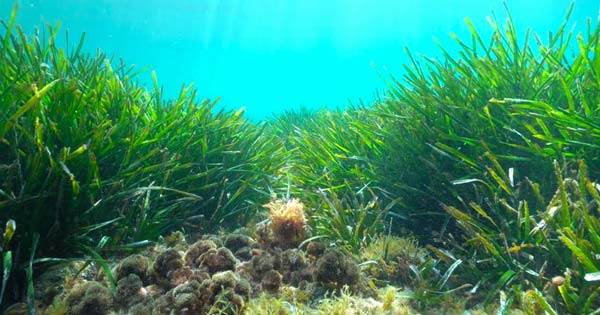
Did you know that Posidonia oceanica isn’t an algae, but a true plant in every sense?!
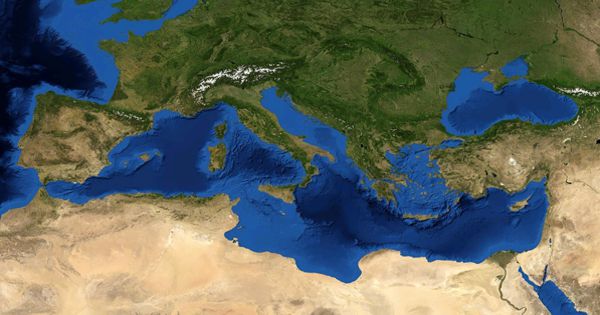
The Posidonia oceanica meadow, now almost disappeared in areas affected by human activity, is abundantly present within the Marine Protected Area of Capo Gallo – Isola delle Femmine, covering extensive areas and offering shelter to a remarkable number of animal and plant species. The MPA offers excellent conditions for establishment and growth, representing the ideal habitat for this hugely important plant, endemic to the Mediterranean Sea.
Seagrasses are far more complex plants than the algae with which they are often confused. Originating from land plants around 100 million years ago, they evolved special adaptations to develop in the marine environment.
Like land plants, Posidonia oceanica has true roots, stems (called rhizomes) and leaves, on average a little over a metre long and about a centimetre thick, and is therefore characterised by organs with tissues specialised for absorbing and transporting water and nutrients, as well as for synthesising and storing the products of photosynthesis.
The rhizomes, which can grow horizontally (plagiotropic) or vertically (orthotropic), undergo a lignification process that prevents decomposition even over hundreds of years.
The plants grow on “matte”, a terrace-like formation made up of a mass of rhizomes and sediment trapped by the leaves themselves, which can reach considerable size. In this way, Posidonia meadows can colonise an environment that would otherwise be difficult for algae to use, given their lack of roots.
Posidonia reproduces sexually, forming hermaphroditic flowers and fruit, and also asexually through growth via stolons. The fruit, commonly known as a “sea olive”, once ripe, between March and May, detaches from the plant and, thanks to its oily content, floats. Carried by the currents, it drifts until it rots, depositing its seeds on the seabed, where they germinate if they find suitable conditions for growth.
The meadow is hugely important for the balance of coastlines and the marine environment, so much so that it is considered a “bioindicator”: its presence indicates moderate current intensity, remarkable water column transparency and excellent biochemical conditions of the waters in which it has taken hold.
We can admire Posidonia during our dives in the MPA of Isola delle Femmine and of Ustica. It lives between 1 and 30 metres depth and tolerates temperatures between 10 and 28 degrees Celsius. It’s a plant that needs constant salinity levels and strong light (limiting factors).
In autumn, we can notice during our dives that the plant sheds its outermost, older leaves, which turn brown and become photosynthetically inactive. Once detached, they play an important role in protecting the coast from waves, reducing erosion: leaves torn away by winter storms are deposited by waves along the shoreline where, piling up, they form structures known as “banquettes”.
Underwater, every part of the plant is colonised by plant and animal organisms: on the leaves you can observe encrusting or filamentous brown and red algae (rhodophyta), together with many bryozoans and hydrozoans (delicate feathery structures); adapted to low light intensity are the organisms that live attached to the substrate formed by leaves and rhizomes, but there are also some mobile organisms, capable of moving around within the meadow: among these the most common are echinoderms such as sea urchins and starfish. Among the molluscs, a regular and almost exclusive inhabitant of the meadows is the Pinna nobilis, the largest bivalve in the Mediterranean Sea, difficult to encounter during our dives as it is heavily threatened by fishing and pollution.
The Posidonia meadow is also an essential nursery, providing protection for the reproduction and growth of juveniles, not only of fish species, but also crustaceans, molluscs and many other organisms.
Interestingly, the genus Posidonia, besides the Mediterranean Sea, is found exclusively along the southern and western coasts of the Australian continent.
The Posidonia meadow is among the most important ecosystems in the Mediterranean Sea (a climax community) and has been identified as a “priority habitat” that must be protected.
PADI courses are geared towards protecting these ecosystems. With an entry-level diving certification such as PADI Open Water Diver, up to a more advanced level like PADI Advanced Open Water Diver, you have the opportunity to explore and discover the hidden wonders among the Posidonia meadows within the MPA of Isola delle Femmine and of Ustica. But even more interesting is learning to identify the various animal and plant species with a specialty diving course such as PADI Project AWARE – Fish Identification or PADI Underwater Naturalist Diver.
Fun facts:
- In the past, the leaves were used as insulation in roof construction, and in pharmacology to treat inflammation and irritation.
- In 2006, a Posidonia plant about 8 km long was discovered in the Balearic Islands, estimated to be 100,000 years old. The plant is found within a meadow that extends over 700 square kilometres, from the Es Freus area (Formentera) to Las Salinas beach (Ibiza).
The importance of Posidonia:
- Thanks to its leaf growth, it releases up to 20 litres of oxygen a day into the environment for every square metre of meadow.
- It produces and exports biomass both to neighbouring ecosystems and to deeper waters.
- It offers shelter and is a breeding area for many fish, cephalopods, bivalves, gastropods, echinoderms and tunicates.
- It consolidates the seabed near the coast, helping to counter excessive transport of fine sediment by coastal currents.
- It acts as a barrier that dampens the force of currents and waves, preventing coastal erosion.
- The dampening of wave motion by the layer of dead leaves on beaches protects them from erosion, especially during winter storms.
Related news